
ESB’s AI recipe for 40% more revenue in Indonesia’s F&B sector
Published on August 23, 2024

In emerging Asia, the implications of AI and Generative AI (GenAI) differ from those in developed markets like the US, Europe, and China. In countries like Indonesia, the vast majority of businesses are micro-enterprises, many of which are underserved by traditional financial institutions due to a lack of formal credit history. This means tens of millions of local F&B outlets in the nation do not have adequate access to business loans and working capital.
AC Ventures in partnership with Boston Consulting Group (BCG), BCG X, and the Indonesian Chamber of Commerce and Industry (Kadin Indonesia), recently released a marquee sector report titled “Harnessing the Power of (Gen)AI in Indonesian Financial Services,” exploring the adoption and impact of GenAI in the country’s financial sector, offering strategic advice for leaders on integrating GenAI into their products and operations.
One of the most compelling case studies from the report was that of ESB Restaurant Technology, a restaurant management SaaS platform that is now using AI and GenAI to transcend industries, entering squarely into the realm of financial inclusion and economic empowerment for Indonesian F&B businesses.
ESB co-founder and CEO Gunawan Woen recently joined an episode of AC Ventures’ signature podcast Indonesia Digital Deconstructed to discuss his company’s new AI breakthrough, OLIN, and how it is helping F&B businesses grow revenue by up to 40% and gain critical access to working capital from local banks and financial institutions.
“ESB is a leading provider of F&B software in Indonesia, delivering end-to-end solutions that cover both in-store automation and backend operations. Beyond offering software as a service, we also support our merchants in managing their supply chain relationships. Last year, we acquired a payment gateway, which has enabled us to handle important transaction and cash flow data. This capability is essential for helping our merchants and their suppliers achieve greater financial stability,” explained Gunawan.
He shared that ESB had been experimenting with and implementing traditional AI solutions into its product since before the GenAI boom in late 2022. Originally, ESB’s AI was baked into its SaaS and allowed users to generate useful insights and actionable intel about their company data. But the user experience was a technical one – not like asking a human expert, for example.
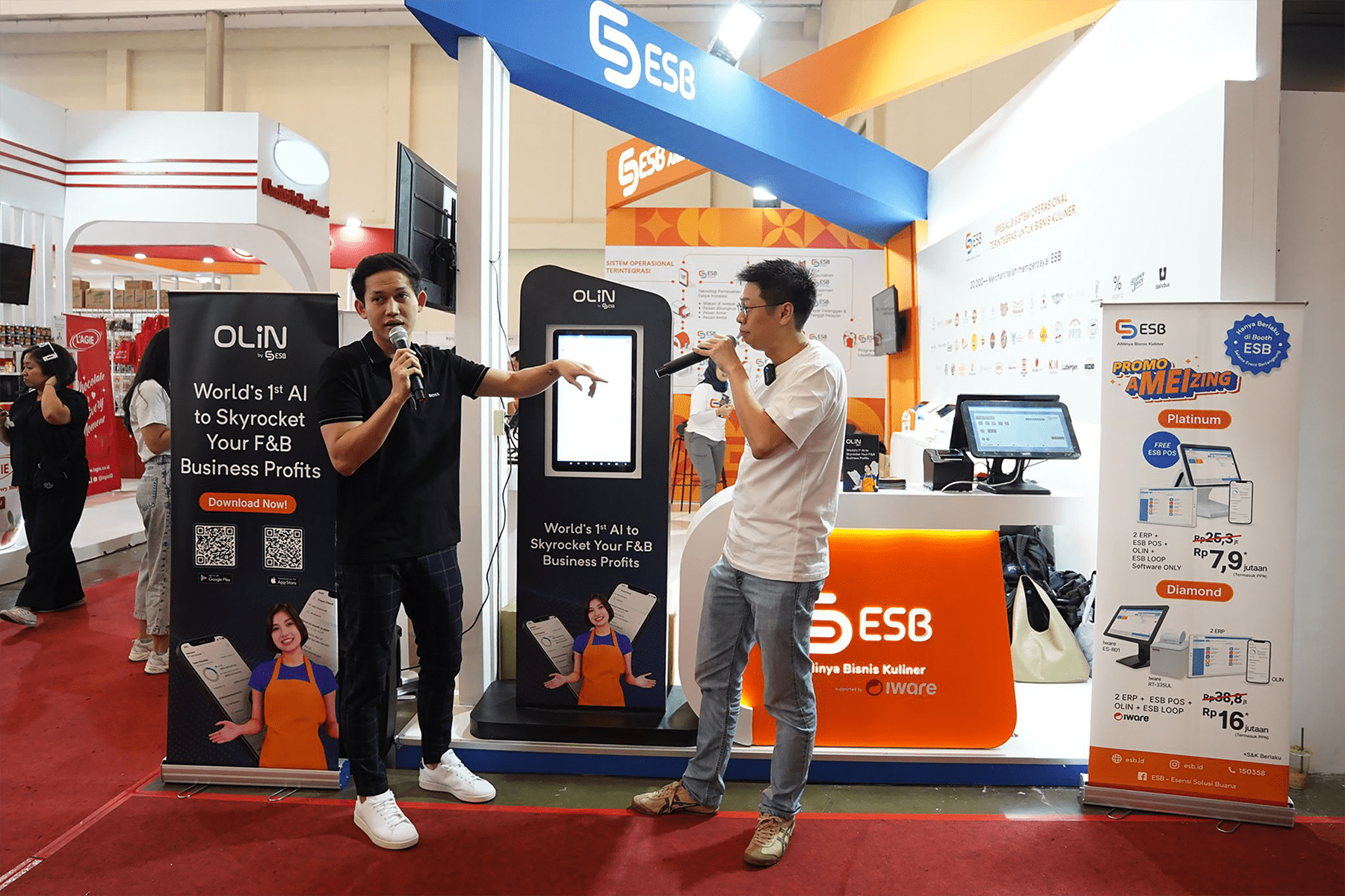
Following the landmark release of ChatGPT in late 2022 and the GenAI flood that followed, ESB quickly moved to marry its traditional AI tech with GenAI to come out with an in-app assistant named OLIN. Taking the form of an on-screen female co-worker, OLIN is an entity that F&B enterprises now need only ask simple questions to. Users no longer need to read or analyze data to arrive at actionable insights. OLIN serves this up for them in a simple-to-digest manner.
Gunawan expanded, “Currently, we are in the initial phase of our AI implementation. In this first phase, our focus is on five key areas. First, we have developed the ability to forecast merchant sales with 90% accuracy. All you need to do is ask OLIN. She will also provide recommendations on menu combinations and pricing strategies to help merchants achieve these forecasts. Additionally, she offers guidance on selecting promotional activities and even incorporates fraud prevention measures with five specific variables to detect and prevent potential sales losses. The fifth focus is on monitoring overall business health.”
He explained that through these methods, F&B merchants in Indonesia who use OLIN are now achieving substantial revenue boosts of up to 40%.
Beyond increased earnings for F&B merchants – which is significant unto itself – ESB is now also addressing one of the largest pieces of the financial inclusion puzzle in Indonesia’s burgeoning economy. With OLIN, ESB is developing innovative credit scoring models for F&B businesses – opening access to bank loans and working capital from the formal financial sector to large swathes of F&B micro-businesses; companies that have historically been viewed as unbankable by traditional financial institutions. In this regard, ESB is transforming itself into an industry-specific fintech company.
Gunawan said, “Currently, we are not acting as the lender ourselves because the product is still in its early stages. Instead, we serve as a conduit between financial institutions and the merchants. We’ve observed a high demand for supplier financing, which is particularly intriguing. With our AI, we analyze the needs of merchants who wish to pay their suppliers and facilitate financing directly.”
He added, “SaaS is the basic offering in our suite. But our future revenue streams extend even beyond financing, with AI as a core driver. Our supply chain and procurement system, linking suppliers with merchants, has excelled since its recent launch—I approved a 15-ton chicken order just last week. Meanwhile, our end-customer ordering system allows seamless transactions without installation, enabling orders and payments both in and outside the restaurant. This not only simplifies transactions but also collects data on customer behavior, utilizing our AI to analyze both merchants and their customers. This gives us troves of proprietary data about specific neighborhoods nationwide in Indonesia and their price preferences for F&B”